


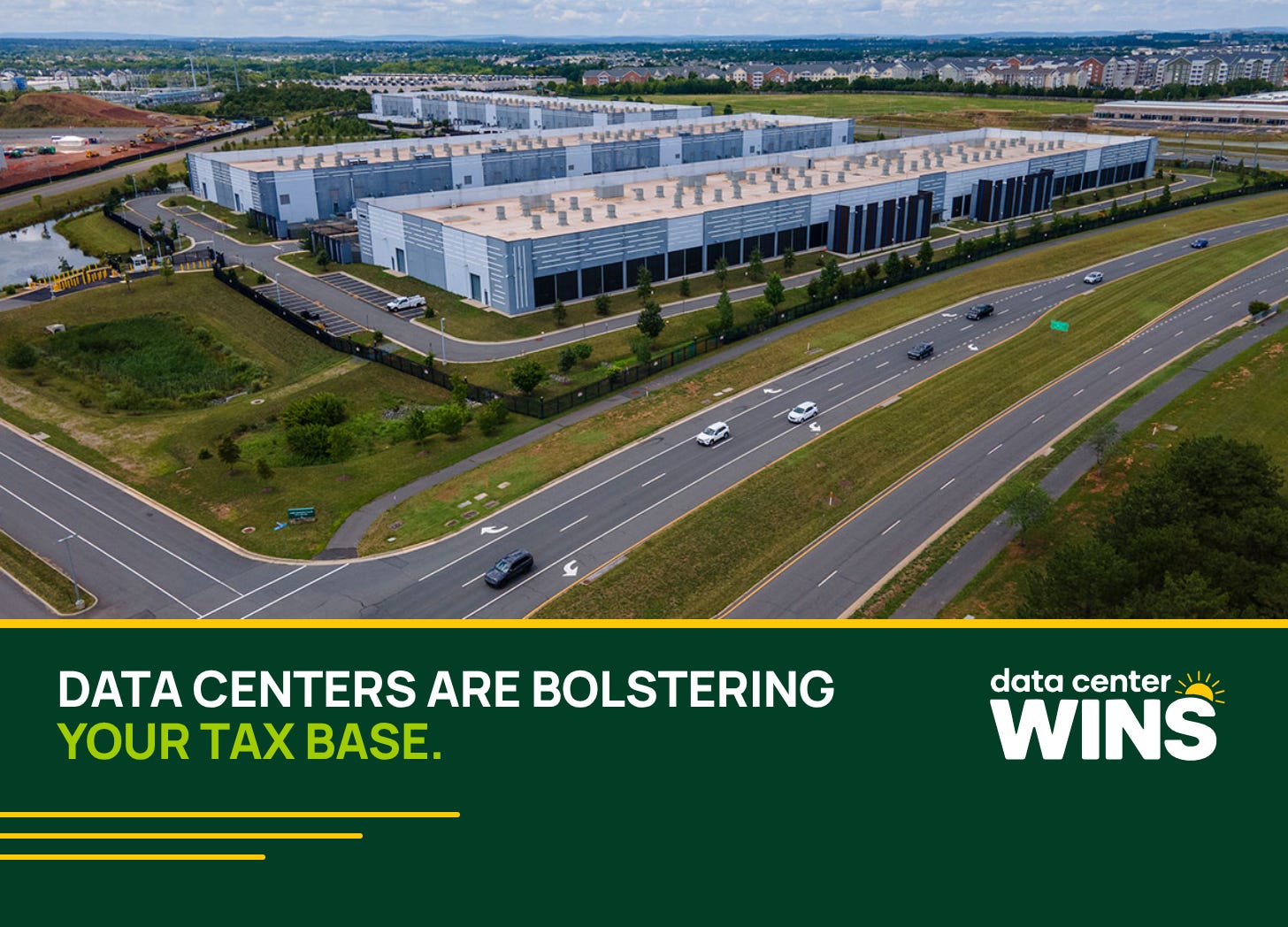
Everybody contributes to our towns through taxes. But some pay more than others.
It doesn’t need a school seat. It doesn’t clog up the roads at rush hour. It doesn’t call the city about a pothole. It just sits there and writes a massive check to your local government every single year.
This amazing neighbor is also known as a data center, and the numbers are incredible.
The Big Picture: Hundreds of Billions
According to a May 2026 PwC report commissioned by the Data Center Coalition, data centers contributed $165 billion in fiscal support to federal, state, and local governments in 2023. The next year, the total jumped by a staggering $39 billion in tax revenue, to $204 billion. This is how those communities spend that new tax revenue to better their lives.
Loudoun County, Virginia
If data centers had a hometown, it would be Loudoun County, and Loudoun is thriving because of it. Data centers take up about 4% of the county’s commercial parcels, yet they bring in 38% of its general fund revenue. This impact is undeniable: for fiscal year 2027, the county is projected to bring in $1.3 billion, roughly 40% of the entire budget.
Fun fact: For every one dollar Loudoun spends on services for data centers, it gets back $26 in tax revenue. This revenue goes directly toward funding schools, public safety, fire and rescue budgets and staff, libraries, and community centers. The excess cash led the county to cut the vehicle property tax and scrap the $25 vehicle license fee entirely.
The county’s property tax rate fell from $1.145 in 2016 to $0.805 per $100 of assessed value in 2026, a drop of about 30%. One analysis found that without data centers, the 2024 rate would have been $1.537, almost double what homeowners actually paid.
Quincy, Washington
Quincy is a small farm town in central Washington.
Back in 2006, just as data center companies started showing up, Grant County’s top 10 taxpayers paid about $4.2 million in taxes. By 2025, seven of the top 10 taxpayers were data centers, and the amount of tax revenue collected was $54.3 million. Six of those data centers are in Quincy.
Because of those data centers, between 2006 and 2025, Quincy’s property tax rate fell more than 70%, going from $3.12 per thousand to $0.88 per thousand.
Data centers now make up an estimated 57% of Quincy’s property tax revenue. That money helped pay for the Q-Plex, a 143,000-square-foot indoor sports complex, plus police and fire stations, a library, a hospital, and more, all of which the city’s former administrator called the “Quincy miracle.”
DeKalb, Illinois
Meta opened a data center in DeKalb in 2023. Here’s what the local school district has collected in property taxes from it since, according to the superintendent:
2023: $2.3 million
2024: $7.1 million
2025: $19 million
2026: $18.8 million
That’s more than 20% of the district’s annual property tax revenue. Local officials say it has helped the district lower property tax rates year after year.
The best part is that data centers pay a ton into school budgets while not adding many new students to classrooms, meaning districts can spend more on what matters most: the children.
Ohio (yes, even with the tax breaks)
Critics love to point out the tax incentives that data centers receive. For example, between 2017 and 2024, Ohio gave data centers $2.5 billion in incentives. It got back $5.2 billion in tax revenue. Every incentive dollar came home with a friend.
Then, in New Albany, a special assessment on data centers brought in $10 million last year. The town used it for a police station expansion, new green space, a playground, and a veterans’ memorial. Data center revenue also helped the local school district skip asking voters for more money.
When data centers win, communities win.
As with every political conversation today, there is nuance. Knee-jerk reactions to the trigger word ‘data center’ ignore the benefits and potential this infrastructure brings our communities. Here are a few more examples because we can’t help ourselves:
Mecklenburg County, VA: Data centers cover a quarter to a third of the county budget. That paid for a new paid EMS service to back up volunteer rescue squads and school renovations.
Henrico County, VA: Officials used data center revenue to seed a $60 million affordable housing fund.
Columbia County, GA: A new Google-affiliated project is expected to bring in about $40 million, earmarked for property tax relief.
Effingham County, GA: An OpenAI data center, along with other changes, could cut homeowners’ annual tax bills by more than $1,000.
Recent Data Center News:
Amazon offers $1 billion to answer community backlash (Fortune, Oct. 5). Amazon’s “Built Together” program would spend $1 billion over five years. It would cover free community college tuition, job training for up to 100,000 workers a year, and energy-efficiency upgrades for more than 30,000 homes and 300 buildings. AWS CEO Matt Garman warned that moratoriums could hurt the U.S. in the AI race. Microsoft and Meta have launched similar community programs. Read
Wall Street is growing skeptical of the data center boom (Philadelphia Inquirer, Oct. 4). SB Energy delayed its IPO after struggling to attract investors at a $50 billion valuation. Nuclear company Holtec indefinitely paused its offering, citing “uncertainty of data center development.” Public opposition and execution risk are pushing companies to rethink their fundraising, though experts still expect trillions in AI infrastructure spending. Read
Big Texas projects keep getting filed (Baxtel, week of Sept. 28 – Oct. 3).
Subscribe to Data Center Wins for more good news from the towns building the future. Find us right here on Substack, where we’ll publish a new column and share must-read stories every week. Follow us on X, Instagram, and TikTok at @DataCenterWins. Reach us at jay@datacenterwins.com