


When most people hear “data center” (especially this year), they picture the vast, warehouse-sized campuses run by giant tech firms.
Those facilities exist, but they are only one piece of the picture: hyperscale sites held about 44% of global capacity at the end of Q1 2025, which means the majority of the world’s data centers do something totally different. Below, we walk through the five main types of data centers, the industries that depend on them most, and where the industry is heading as AI reshapes demand.
The Five Main Types of Data Centers
A data center is a physical facility housing the servers, storage, and networking gear organizations use to run applications and store data. In a different era, we used to call them server farms. Types differ by ownership, size, and location.
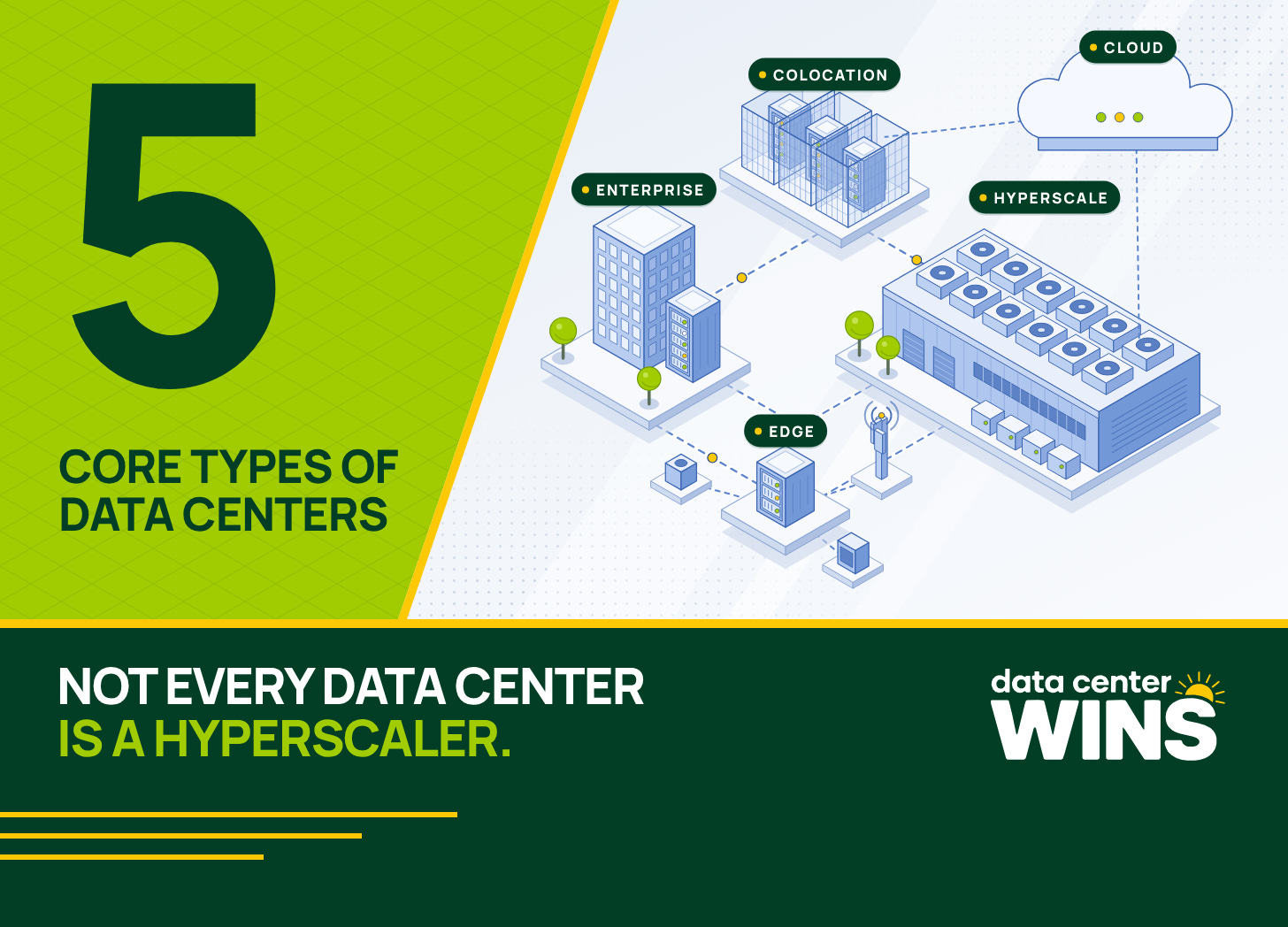
Hyperscale: Large facilities built for cloud-scale compute and storage. Synergy Research Group counted 1,189 worldwide at the end of Q1 2025.
Colocation: Shared facilities where businesses rent space, power, cooling, security, and connectivity while supplying and managing their own servers. Colocation data centers are the digital equivalent of a coworking space.
Enterprise (on-premises): Owned and operated by a single organization or company, often on a corporate campus. They usually power a company’s specific functions or internal tools.
Edge: Smaller facilities placed close to end users and devices to cut latency, supporting internet-connected appliances, video streaming, and autonomous systems.
Cloud: Facilities run by providers such as AWS, Google Cloud, and Microsoft Azure that deliver compute and storage on demand, so customers never own the hardware.
The Industries Most Reliant on Data Centers
Technology and digital services are the primary drivers of hyperscale growth, relying on hyperscale and colocation for SaaS delivery and AI training and inference.
Financial services depend on colocation and enterprise facilities for transaction processing, fraud detection, and online banking, where downtime means financial risk.
Healthcare and life sciences use enterprise, colocation, and edge facilities to manage electronic health records, medical imaging, and research data under strict privacy rules.
Manufacturing pairs centralized analytics and ERP systems with edge processing near production lines to run automation and digital twins.
Media, streaming, and gaming need hyperscale, colocation, and edge capacity to deliver content with low latency worldwide.
Government agencies rely mainly on enterprise and colocation facilities, with growing cloud use, for citizen services, records, and mission-critical operations.
The Future of Data Centers
Hybrid is now the default. Gartner predicts 90% of organizations will adopt a hybrid cloud approach through 2027, and CoreSite’s 2026 State of the Data Center survey of more than 300 IT leaders found that security, uptime, and performance have overtaken cost in deciding where workloads run.
AI is accelerating that shift. Foundry found 58% of organizations had implemented or were upgrading AI, up from 39% a year earlier. AI’s appetite for dense power, cooling, and low-latency cloud links is pulling these workloads toward colocation and hybrid setups; 79% of surveyed leaders call direct cloud interconnection very important.
Power and space will be the defining constraints. The International Energy Agency expects data center electricity demand to more than double by 2030, GPUs draw 10 to 15 times more power per processing cycle than CPUs, and North American vacancy hit a record low of 1.6% in mid-2025. Organizations that plan capacity early and match each workload to the right facility will be best positioned for what comes next.
Data center news you should know:
Subscribe to Data Center Wins for more good news from the towns building the future. You can find us on X, Instagram, and TikTok at @DataCenterWins.