


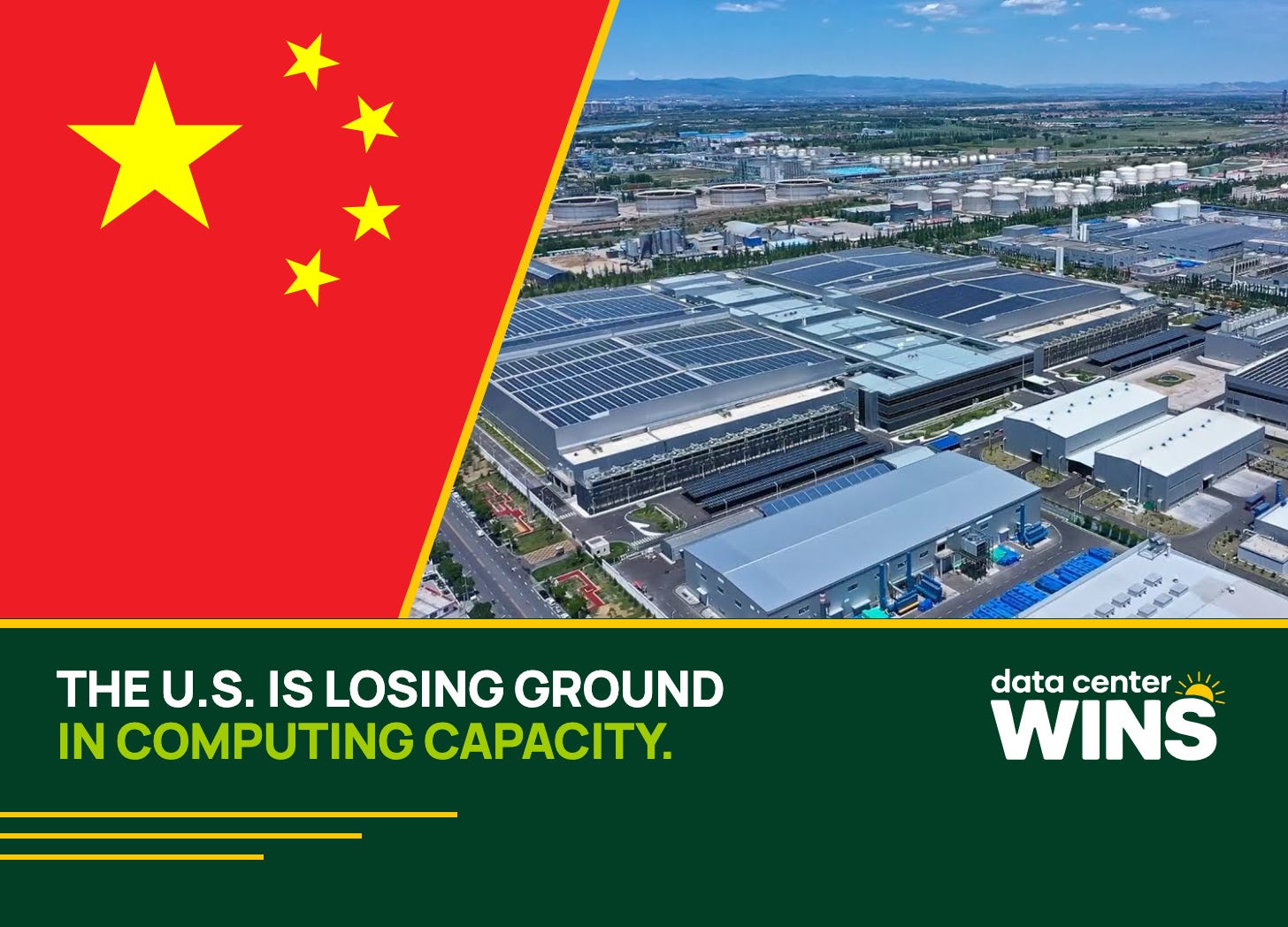
The data center race between the U.S. and China is heating up. In Ulanqab, a farm town in Inner Mongolia, 89 data centers are built or planned, the Financial Times reports.
Why it matters: The U.S. still leads in data center capacity, and every town that says yes to a data center adds to our global advantage. It’s a win for the U.S. economy, local towns and cities, and our ability to compete on the world stage in the age of A.I. However, China now leads in total planned computing capacity:
56GW of live data center capacity in the U.S.
24GW in China, more than the rest of Asia combined.
50GW more is under construction or announced in China.
12 to 18 months: when many Ulanqab sites are scheduled to finish. U.S. builds typically take 18 to 24 months.
China’s bottleneck is chips, due to limits on buying Nvidia hardware and thin output from its own manufacturing facilities. In contrast, the United States has greater chip capacity but less infrastructure and grid capacity, per the Times. The American towns that already said “yes” to data centers are helping our country win, and the future is built on our ability to model their success:
DeKalb, Illinois: the school district collected $2.3 million from Meta’s data center in 2023. In 2026? $18.8 million.
Loudoun County, Virginia: data centers are projected to bring in $1.3 billion in fiscal 2027. That’s 40% of the county’s total budget.
The competition between the United States and China on the frontier of A.I. and data centers is high-stakes. China knows whoever wins this race will win the world for the next era. Our future lies with communities and towns that are embracing data centers, the opportunities they bring, and their role in the new American economy.
Data center news you should know:
Subscribe to Data Center Wins for more good news from the towns building the future. You can find us on X, Instagram, and TikTok at @DataCenterWins. You can reach us at jay@datacenterwins.com.