


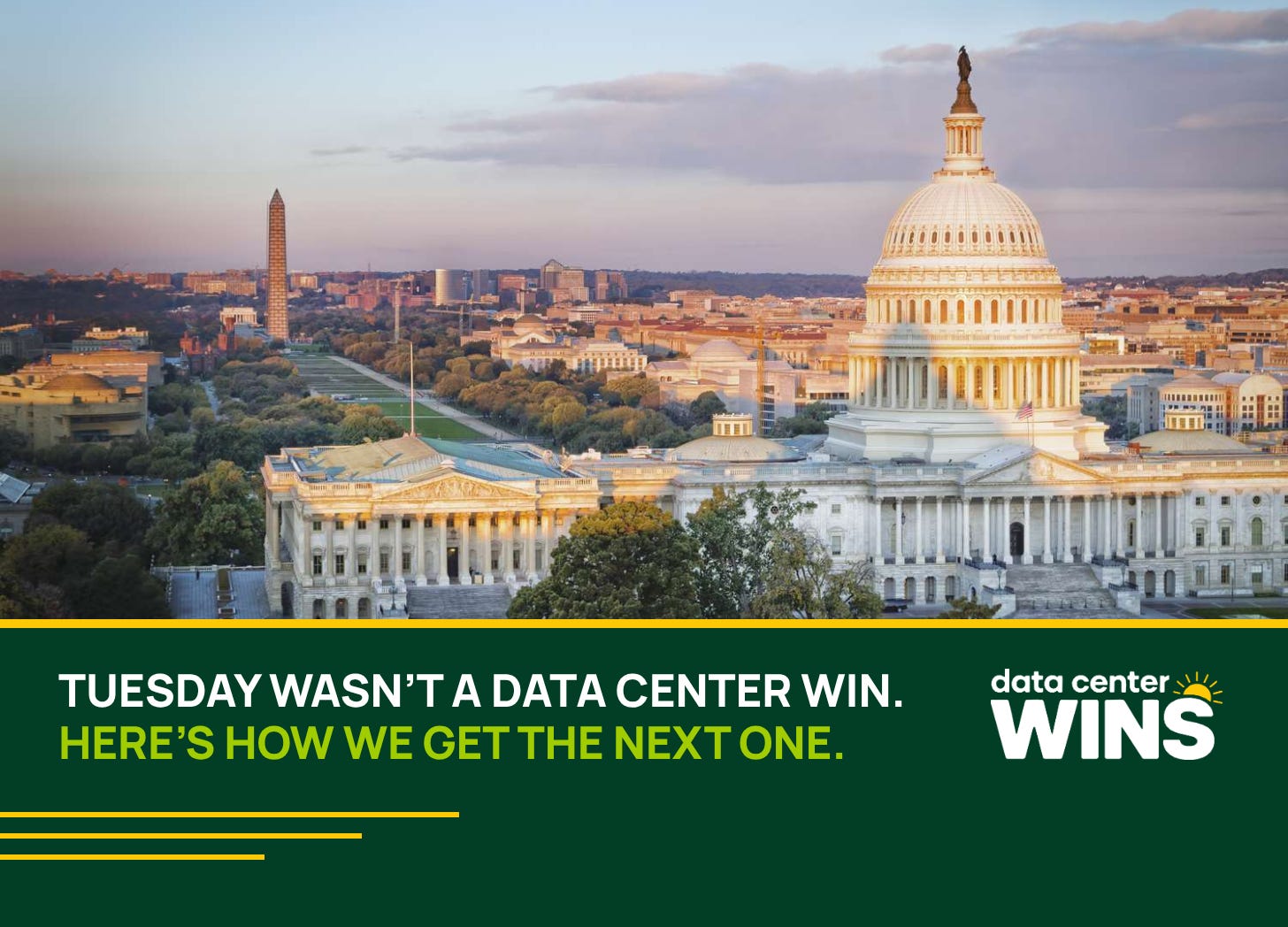
At Data Center Wins, good news is kind of our whole thing. Lower tax bills. New schools. Union paychecks. We believe data centers are good for this country’s economy and can do a lot of good for the towns that host them, and we will never get tired of saying so.
But sometimes it’s important to acknowledge the bad news, because it’s the truth: Tuesday was a bad night for data centers. There’s no sugarcoating it.
But buried in the bad news is a pretty clear pathway back to yes.
The results we didn’t want
Going into Election Day, Ballotpedia counted 41 data center measures on local ballots in 10 states, more than half of them in Ohio. By Wednesday, CNBC reported that voters had rebuffed data centers in every ballot measure except one.
It went beyond ballot measures. In Piqua, Ohio, and Yukon, Oklahoma, voters recalled their mayors over past support for data center projects. And in the national exit poll, 76% of voters said they oppose building a new data center in their own community.
To be clear: data centers weren’t the only driving issue in this election. Of the five issues exit pollsters asked about, AI and data centers came last, well behind government corruption (90%) and the cost of living (89%).
But 56% of voters still called AI and data centers a crucial or major factor in their vote. And in a University of Houston poll of likely Texas voters last month, 76% said a new data center would raise electricity costs in their community.
Texas: The biggest wake-up call
The biggest result of the night for our industry was in Texas, where Gina Hinojosa unseated Gov. Greg Abbott after campaigning on a temporary ban on data center construction.
Texas accounts for 25% to 30% of the data center capacity expected to come online by 2030, according to analyst Dan Ives. And the state was already on pause: Abbott had suspended data center approvals before Election Day. The election result was a very clear message from voters about slowing down data center construction.
But read Hinojosa’s platform closely and you’ll see a temporary ban isn’t “never.” She’s called for a pause until the Legislature writes rules, and her list of asks is specific: hire union labor, drop the nondisclosure agreements, end the subsidies and prove households won’t pay more for electricity or water.
That’s a to-do list, and a pretty fair one. We can’t build through a ban, but we can build through a to-do list.
Voters told us what yes looks like
In an October poll by Fabrizio Ward and Impact Research (Trump’s pollster and Biden’s pollster, together for once), 58% of voters said they oppose building data centers in their state. But 54% said they’d support construction if companies committed to cover their own electricity costs, protect customers from higher bills and safeguard water and environmental resources. Only 31% still said no outright.
Put it together and the message is pretty clear. Voters aren’t saying never. They’re saying not on my dime, and not without a say.
Why DCW exists
By the final week of the election, campaigns and outside groups had spent $173 million on ads about data centers in the general election, according to AdImpact. Almost all of them were negative.
That’s $173 million telling voters what data centers would cost them. Who was telling them how data centers would help them?
Not nearly enough of us. Drab press releases about data center benefits were never going to win that fight. That’s why DCW exists, and Tuesday is why this work matters more now than it did a week ago. The industry, and everyone who believes in it, has to get a lot better at showing and delivering the wins.
Show the receipts
The good news (you knew it was coming) is that the receipts already exist.
Taxes: Loudoun County, Virginia, says it gets $26 in tax revenue for every $1 it spends providing services to data centers. That’s the county’s own number.
Schools: In DeKalb, Illinois, schools collected $2.3 million from Meta’s data center in 2023. In 2026? $18.8 million. The district says it has lowered its tax rate each of the past five years, in part because of data center revenue.
Jobs: At a Loudoun County town hall this summer, IBEW Local 26’s Don Slaiman said his union worked 20 million hours last year and is headed for “north of 33 million.”
Power bills: Amazon, Google, Meta, Microsoft, OpenAI and other big builders have committed, through the Ratepayer Protection Pledge, to pay for the new power generation and grid upgrades their data centers need.
Water: In Quincy, Washington, a city water-recycling system supplies cooling water to Microsoft’s data center, which the EPA says lowers the region’s use of drinking-quality groundwater.
Now we build
Tuesday should be a wake-up call for everyone who believes that data centers are important for the future of our country and towns. But it’s not enough to build them - data centers need to be good neighbors to the towns and communities they serve.
When data centers win, communities can win. Tuesday, they didn’t. It’s time to turn that around.
Subscribe to Data Center Wins for more good news from the towns building the future.